
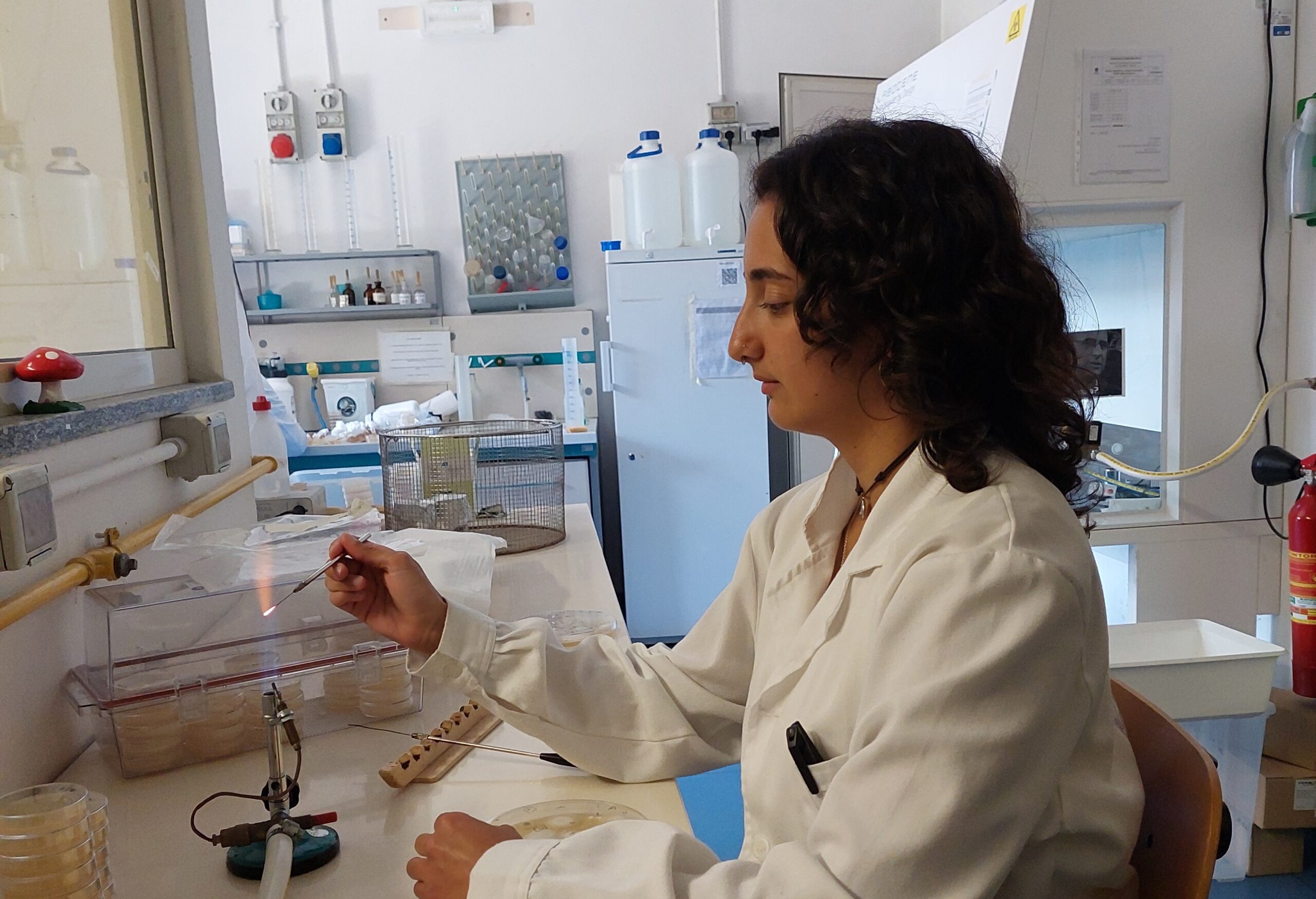
Picture courtesy of Mycotheca Universitatis Taurinensis and Silvia Quintana.
The Pyrénées are home to mountain grasslands that are shaped by centuries of traditional grazing and extremely rich in biodiversity. Silvia Quintana, a doctoral student at the University of Zaragoza and environmental scientist, studies how this livestock husbandry techniques impacts vegetation, soil quality and biodiversity in these mountain ecosystems.
«My research focuses on the impact of grazing intensity on soil and vegetation in the Pyrénées», she explains. In traditional grazing methods, cows roam freely and consume wild vegetation, helping manage the balance between grasslands and forests. «Cows contribute to the protection of grasslands, that would turn into forests otherwise. We try to highlight the positive effects of these techniques: grasslands are more biodiverse than forests, and less prone to fires.» The interplay between livestock husbandry and fires is called pyric herbivory: as livestock prefer to graze recently burned areas, plants grow more in unburned areas, which then burn more easily. This means that different areas burn and are grazed at different times, creating more variety in the number and types of plants present.
Cows contribute to the protection of grasslands, that would turn into forests otherwise.
In her work, Quintana takes an holistic point of view, studying the ecosystem as a whole: «In studying how different grazing intensities impact the soil, we look at many different properties: biological, chemical, and physical.» This multifaceted approach brought her to Torino: in June and July, Quintana visited the Mycotheca Universitatis Taurinensis of the University of Torino through the Trans-National Access (TNA) programme of the MICROBES-4-CLIMATE project, funded by the European Union’s Horizon Europe research and innovation programme (Grant Agreement No. 101131818), and the ERASMUS+ programme. During her time in Torino, she learnt fungal isolation and identification techniques. «We have decided to focus on fungi and try to understand how their biodiversity varies when the soil is subject to different grazing intensities: how many cows are there, how frequently they go up the mountain…»
There is so much more to learn and to do in this topic, and I’d like to come back again.
She would not have had the opportunity to learn those techniques at her home university, where she works with an interdisciplinary group of veterinarians, agronomists, and government officials: «This is my second time in Torino, and hopefully there will be a third. There is so much more to learn and to do in this topic, and I’d like to come back again.» The city itself was also a selling point: «It is a big city but unlike other big cities, it is quite nice, calm, there aren’t a lot of people or tourists. I really liked my time there.»


